
Your Brain Is a Wet Computer (And It’s Been Infected)
- Glenn

- Dec 14, 2025
- 7 min read
Have you ever wondered why an hour spent drifting through social media leaves you feeling anxious, scattered, and oddly hollow, as though some essential part of you has been quietly siphoned away? Or why a half-day spent creating something with your hands, reading a book, or losing yourself in the quiet rhythm of a walk leaves you feeling restored in a way that feels deeper than simple relaxation?
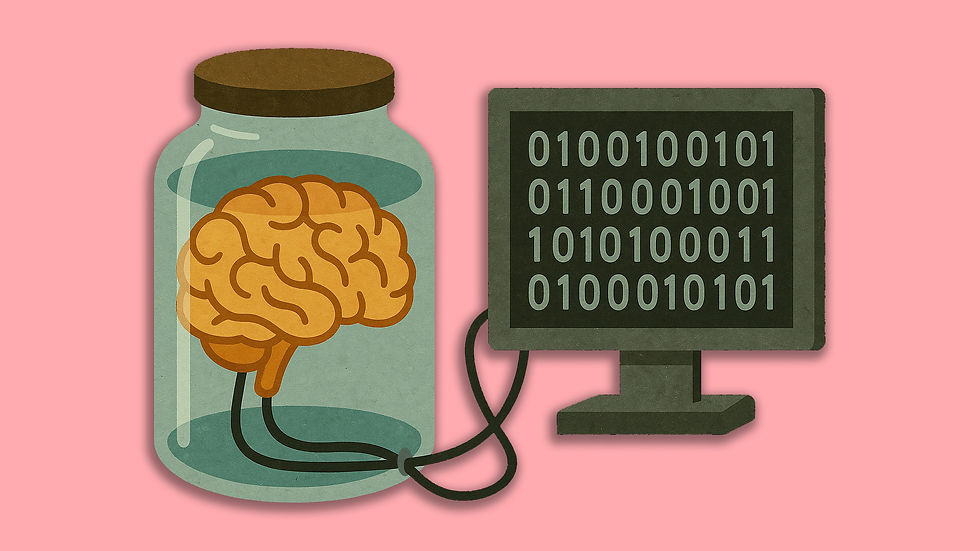
The contrast between those two states isn’t mysterious or abstract. It’s rooted in something far more mechanical and far more predictable. Because when you look past the messiness of human emotion and the complexity of consciousness, our brains behave remarkably like computers. They absorb and process information, form connections, sort patterns, execute scripts and respond to inputs. They upload the world around them and run it as code.
What we often forget is that this computer is a wet one. A biological processor shaped across millions of years of slow evolution. A soft, flexible, organic CPU that runs whatever software we allow into it. Most of the time we don’t even realise what has been installed, because human memory doesn’t label files neatly or show you a list of active programmes. It simply updates in the background.
But in a world saturated with algorithmic feeds and frictionless entertainment, many of us are installing mental software that is cheap, unstable and riddled with hidden processes. If you have ever opened your phone intending to check one thing and then found yourself twenty minutes later scrolling through videos you have no memory of voluntarily choosing, that behaviour isn’t an accident. It’s a programme quietly running inside your biological operating system.
The good news is that none of this is irreversible. You can choose the code you run. You can uninstall what drains you. And you can begin reinstalling the timeless, resilient human programmes that served our species well long before the first screen flickered to life.
This article explores why our minds are so vulnerable to modern input, where this fragility came from, and how you can begin reclaiming your internal operating system. So make sure there’s a little room on your mental hard drive, because the update I’m about to offer is worth installing.
The Wet Computer
We often talk about modern life as though it is overwhelming because it is busy or stressful or fast, but the truth is far simpler. Our brains haven’t meaningfully changed in over 100,000 years. The same hardware that powered hunter-gatherers now powers people flicking through six hundred videos in an evening. The system hasn’t been upgraded. Only the environment has.
Medieval farmers, eighteenth-century sailors, Victorian factory workers and modern digital natives all share the same biological CPU. They differ only in the software they were forced to run by the time and culture they lived in. Medieval OS. Industrial OS. Digital OS. Each built on identical neurons, synapses and chemical responses.
The problem is that digital society has evolved at a pace biology simply cannot match. Computers you buy at home upgrade their hardware every few years. Humans do not. We are running twenty-first century software on Stone Age architecture. It is the equivalent of trying to load a modern operating system onto a machine that was designed to perform one task at a time. The result isn’t failure, but instability, lag, and a kind of existential overheating that many people interpret as anxiety, impatience or emotional exhaustion.
Worse still, our brains have no firewall. No default antivirus. No natural barrier that differentiates healthy input from corrosive input. Everything gets absorbed because our minds evolved in a world where information travelled slowly and came from people we trusted.
But today, algorithms curate our inputs. Infinite content streams bypass conscious choice. We absorb not only ideas, but micro-behaviours, emotional cues, addictive loops, and mental habits disguised as entertainment. Modern digital life is installing patches and updates we never asked for.
And all of it is seeping into the deepest layers of human code.
Shareware for the Mind
Much of the software we install today comes in the form of the quickest, cheapest and noisiest content ever produced. Platforms like TikTok, Instagram and YouTube Shorts specialise in micro-programmes that crawl straight into the brain’s reward circuitry. They load instantly and offer a tiny burst of stimulation in exchange for your attention.
We believe we are choosing these clips, but in reality we are responding to scripts that were crafted through behavioural science and refined through billions of data points. They are frictionless because friction slows consumption. They are rapid because slowness encourages reflection. And they are wrapped in a dopamine-rich feedback loop that makes the brain crave the next spike before the current one has even faded.
This is shareware for the human mind - free to install, but costly once you realise what came packaged inside. These micro-programmes bring with them pop ups disguised as trends, adware disguised as influencers and tracking scripts disguised as recommendations.
They overwrite deep processes that humans relied on for centuries. Patience. Imagination. Long-form focus. They corrode attention by chopping thought into fragments. They overwhelm the emotional system by delivering too much novelty in too narrow a timeframe. And they dull our ability to tolerate boredom, which has always been the gateway to genuine creativity.
The wet computer was never designed for this. It evolved for a world of slow sensory detail, long stretches of stillness and the gentle rhythm of human conversation—a world where information travelled at the speed of life, not the speed of algorithms.
And when you install too much of this digital shareware, your internal operating system begins to stutter, fragment and glitch.
Pure Code
For most of human history, our mental software was slow to install. Craft, music, storytelling, physical work, reading, and making things from scratch all required time, focus and repetition. These activities didn’t simply occupy the mind. They shaped it. They encoded long-lasting patterns that built resilience, attention, imagination and emotional depth.
This older software wasn’t designed for speed. It was designed for richness. It brought the body into the process. It engaged multiple senses at once. It asked for patience and rewarded it with a feeling of connection—both to the world and to oneself.
Walking, shaping clay, tending a garden, carving wood, or losing yourself in a book all run like stable background processes. They don’t hijack your CPU. They anchor it. They run quietly and coherently alongside everything else.
These ancient forms of mental code carry no ads. They don’t track your behaviour. They don’t manipulate your impulses. They’re not optimised for engagement, because engagement wasn’t the goal. They developed across generations because they worked. They sustained us. They aligned with the architecture of our biological hardware.
And when you reinstall these programmes, something remarkable happens. The jittering stops. Your mental noise quietens. You feel your attention beginning to sharpen and your emotions settling into a calmer, deeper register. Your internal fan slows down, and everything runs closer to the speed it was designed for.
Pure code doesn’t just avoid corrupting the system. It actively repairs it.
Mixing the Best of All Human OS Versions
People often make the mistake of thinking they must choose one era to live in mentally. You are either digital or analogue. You are either a creature of modern convenience or someone who rejects it in favour of tradition. But humans have never lived like that. We have always blended eras. We wear clothes from the present while carrying ancient impulses. We use modern tools to satisfy prehistoric needs.
The real opportunity lies in consciously mixing software from across centuries. You can run Medieval Craft OS alongside Modern Critical Thinking OS. You can uninstall Consumerism OS and replace it with Curiosity OS. You can reinstall Reflection OS while keeping twenty-first century Diversity OS.
Your mind is modular. Infinitely customisable. Capable of running legacy programmes and modern ones at the same time. The mistake is assuming the digital world must dictate the whole stack of your operating system. It doesn’t.
By mixing these codes intentionally, you create something new—a layered human OS that is not old or new, but balanced. One that supports attention while still embracing the power of technology. One that honours depth without rejecting progress. One that places human experience back at the centre instead of treating it as an afterthought.
This is where our species thrives. Not by abandoning technology, but by integrating it into a much older architecture with care and consciousness.
Become the Administrator of Your Mind
Over the past year I’ve found myself uninstalling a lot of corrupted code. I’ve stepped away from the digital platforms that drained me, refused to let algorithms dictate what enters my mind, and shifted my time gradually towards making instead of consuming. It hasn’t been an act of rejection. It’s been an act of repair.
I realised that I had allowed automatic updates to run my internal OS for far too long. I had accepted whatever code was pushed to me through feeds, trends, notifications and noise. I had handed over administrator rights without even noticing. But you do not have to run the operating system society pre-loads you with. You can override it. You can build your own.
This isn’t about temporary digital detoxes. It’s about reshaping your inputs permanently and selecting the processes you want operating in the background. It’s about reinstalling the slow, stable, ancient programmes that always kept us grounded and imaginative and quietly human.
Walking, reading, craft, and curiosity. Presence, and conversation. All of these are freely available. They cost nothing and yet they restore everything. They align with the biological hardware you were born with instead of fighting against it.
If your mind is a wet computer, then you are the system operator. You decide which code to install, what to remove, and how your internal processes should run. Reality may be noisy, and algorithms may be relentless, but your internal OS is yours alone. Every time you choose depth over noise, creation over consumption, or slowness over speed, you rewrite your system a little. You reclaim a fragment of your attention. You strengthen the architecture that makes you human.
Because while your brain might be a wet computer, you are still the administrator. You have the power to choose the code you run.
So choose wisely.
Watch the accompanying YouTube video, and join the conversation now...


Comments