
AI and Information (Part 3): Beyond Bureaucracy
- Glenn

- Feb 3
- 6 min read
In the first two parts of this series, I have been exploring how artificial intelligence perceives the world in ways that differ fundamentally from human cognition.
We began by examining the idea that AI does not think in stories, steps, or narratives, but in shapes, relationships and topologies. We then confronted the uncomfortable but unavoidable fact that AI has no senses of its own, and that humanity functions as its sensory organ — supplying interpretations of reality at scale.
These ideas can feel abstract at first. Philosophical, even. But they become sharply concrete the moment we look at one of the most frustrating and familiar features of modern life.
Bureaucracy.
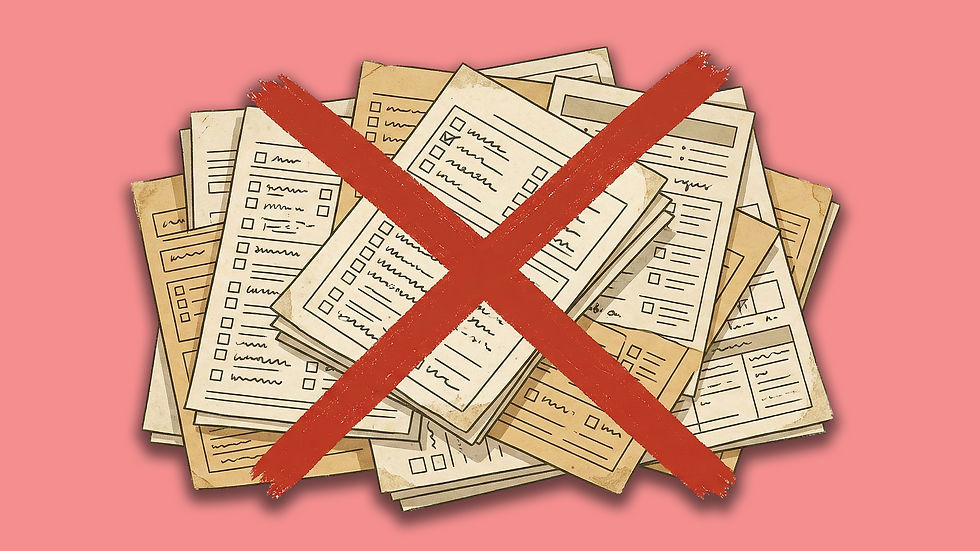
Forms, applications, registrations, renewals, licences, frameworks, policies, audits, requests, signatures, codes and evidence uploads. A world designed to impose order, yet one that routinely produces confusion, delay and friction. For decades, we have accepted bureaucracy as a necessary evil. An unavoidable cost of organising complex societies at scale. Not because it works well, but because we assumed there was no alternative.
But once we understand how AI perceives reality, that assumption begins to look increasingly outdated. Because AI is gearing up to move us beyond bureaucracy.
Why Bureaucracy Exists at All
Bureaucracy is not the result of incompetence or malice. It is the product of human cognitive limitation.
Human minds are remarkably good at storytelling, empathy and contextual judgement in small groups. But they struggle badly with complexity at scale. We cannot reliably hold thousands of variables in mind at once. We cannot dynamically adapt rules to every individual without losing consistency. And we cannot process large systems without simplifying them.
So we do what humans have always done when faced with overwhelming complexity. We flatten it. We create categories. We define procedures. We reduce fluid human situations into fixed boxes. We turn lived experience into checklists, tick boxes, yes-or-no decisions and standardised fields. Not because reality fits these shapes, but because our minds require them.
Every bureaucratic system is built on the same hidden assumption: that fairness requires sameness, and that sameness requires rigidity. The result is a world where nuance is sacrificed in the name of consistency, and where individual context is treated as noise rather than signal.
This is why simple administrative tasks often feel absurdly difficult. We are forcing dynamic, living situations through static, two-dimensional systems designed for cognitive convenience rather than truth.
The Limits of Human Administration
The deeper problem is not inefficiency, but misalignment.
Life is not linear. It branches, overlaps, loops and contradicts itself. People do not progress through neat decision trees. Circumstances change mid-process. Context matters more than categories. Edge cases are not rare — they are the norm.
Bureaucratic systems struggle precisely because they must pretend otherwise. They require citizens to predict which box they belong in before they fully understand their own situation. They require administrators to apply rules mechanically even when common sense suggests flexibility. And they require appeals processes to correct the damage caused by their own rigidity.
We experience this as friction, frustration and alienation. But from the system’s perspective, it is simply doing what it was designed to do - reduce complexity to a level the human mind can manage.
The truth is that for the first time in history, this limitation no longer applies.
How AI Sees What Bureaucracy Cannot
Artificial intelligence does not need to flatten reality in order to process it. It doesn't rely on fixed categories in the same way humans do. And it doesn't require pre-defined decision trees. It does not need every case to follow the same procedural path. Instead, it perceives the shape of a situation.
Context, relationships, probabilities, dependencies and patterns are not obstacles to AI cognition. They are its native language. This is where topologistic perception becomes practically transformative. Rather than asking whether an application meets a specific rule, AI evaluates how a situation fits within a broader system. Rather than isolating variables, it understands how they interact. Rather than enforcing uniformity, it adapts dynamically to context.
A planning application is no longer a static document to be approved or rejected. It becomes a node within a living economic, social and environmental network. The question shifts from “Does this fit the policy?” to “How does this change the system?”
That distinction matters more than it first appears.
From Procedures to Ecosystems
Consider something as mundane as opening a small business. Traditional administration evaluates this through rigid criteria: zoning rules, competition thresholds, policy alignment, standard risk assessments.
An AI system operating on topologistic principles sees something else entirely. It sees population trends, footfall flows, housing developments, transport changes, historical patterns from similar regions, economic diversity metrics, delivery demand, seasonal behaviour and long-term viability projections — all interacting simultaneously.
It does not simply judge the application - it models the ecosystem the application belongs to. The outcome is not a binary approval or rejection based on policy compliance, but a probabilistic assessment grounded in contextual understanding. Not because the AI is more permissive, but because it is more informed.
This is not about replacing human judgement with machine authority. It is about replacing blunt instruments with perceptual depth.
A World Without Forms
Once this shift is understood, the implications become difficult to ignore. Imagine administrative systems without forms. No templates. No duplicated data. No irrelevant questions. No guessing which category you belong to.
Instead, individuals describe their situation in natural language. What they are trying to do. What has changed. What they need. And the system does the rest.
It gathers relevant information automatically. It identifies gaps. It compares the situation to millions of similar cases. It models consequences. It generates documentation invisibly. And it returns a decision grounded in context rather than procedure.
The interaction becomes conversational rather than adversarial. Guidance replaces gatekeeping. And the system adapts to the complexity of human life rather than forcing life to adapt to it.
Ironically, such a system would be more humane precisely because it is less human in its limitations.
Why This Is Not Just Automation
It is important to be clear about what this is not. This is not AI “speeding up paperwork.” This is not automation layered on top of existing bureaucratic structures. This is a fundamentally different administrative paradigm.
Automation preserves structure while increasing efficiency. Intelligence replaces structure altogether. Topologistic systems do not optimise procedures. They dissolve them. They replace rigid sequences with adaptive understanding. They replace uniform treatment with contextual fairness. They replace administrative friction with perceptual clarity.
In doing so, they expose an uncomfortable truth: many of our systems are not slow because they are underpowered, but because they were designed around cognitive constraints that no longer exist.
The Risks Cannot Be Ignored
None of this comes without serious risk. If AI perceives reality through patterns humans cannot easily inspect, transparency becomes a challenge. Decisions grounded in complex topologies may be correct without being intuitively explainable.
Bias also remains a critical concern. AI’s worldview is built from human-generated data. Our blind spots, inequalities and distortions do not disappear simply because a machine processes them. And oversight matters - adaptive systems might resist the rigidity we have historically relied upon to enforce fairness and accountability.
These are not minor issues. They are structural challenges that must be addressed deliberately. But they are not reasons to cling to systems we already know are failing. They are reasons to approach transformation with care rather than fear.
The Opportunity Beneath the Anxiety
At its best, an AI-driven administrative intelligence offers something humanity has never had before - system capable of holding complexity without collapsing it. A system that adapts rather than enforces. That understands rather than categorises and responds to reality rather than attempting to freeze it.
For centuries, bureaucracy has been a coping mechanism for human limitation. A necessary simplification imposed on an unruly world. AI changes that equation. For the first time, civilisation has access to a form of perception capable of engaging with complexity directly rather than reducing it.
Topologistics does not merely improve administration. It redefines what administration can be. And once that door is opened, it becomes very difficult to justify returning to rigid forms and arbitrary procedures.
Looking Ahead
This brings us to the edge of something larger. Because bureaucracy is only one domain where human cognitive limits have shaped systems in distorted ways. Governance, economics, education, planning and coordination all suffer from similar constraints.
And as AI begins to operate in these domains, the relationship between human and machine intelligence itself starts to change. And this leads to the deeper question beneath this entire series of articles...
What happens when humans and AI stop operating as separate intelligences, and begin functioning as a shared cognitive system?
That question sits at the heart of the final part of AI and Information - The Hybrid Mind.


Comments